[A scattered blog post with lots of eye candy.]
Fractals
 |
Romanesco
Broccoli. Photo by Jon Sullivan, licensed under public domain via Wikimedia
Commons
|
Wow. Yes, that is broccoli, and yes, I have eaten one of these. What delights the eye though, about the Romanesco Broccoli is its elegant resemblance to a complex mathematical structure known as a fractal. Notice how each small cone-like growth is patterned with smaller cones, that each are patterned with smaller cones, that each are... you get the point? Although mathematically this "self-similar" sequence iterates into infinite detail, many natural structures exhibit unavoidable similarity to fractals.
Even the thundering stampede of charge in a lightning bolt propagates in a fractal-like pattern (see Video 1 at end):
Even the thundering stampede of charge in a lightning bolt propagates in a fractal-like pattern (see Video 1 at end):
 |
Electrifying
volcanic lightning from photography.nationalgeographic.com
|
In fact, this pattern also manifests itself in tree branches, blood vessels, river networks, and leaf veins (to name a few):
 |
| Branches. Under public domain via Wikimedia Commons |
 |
| Blood vessels from http://blogs.uoregon.edu/artofnature. |
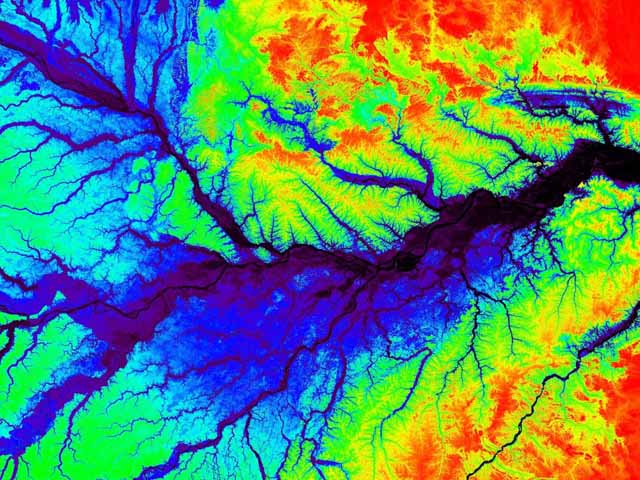 |
| Amazon river basin from Global Rain Forest Mapping Project/NASA/JPL |
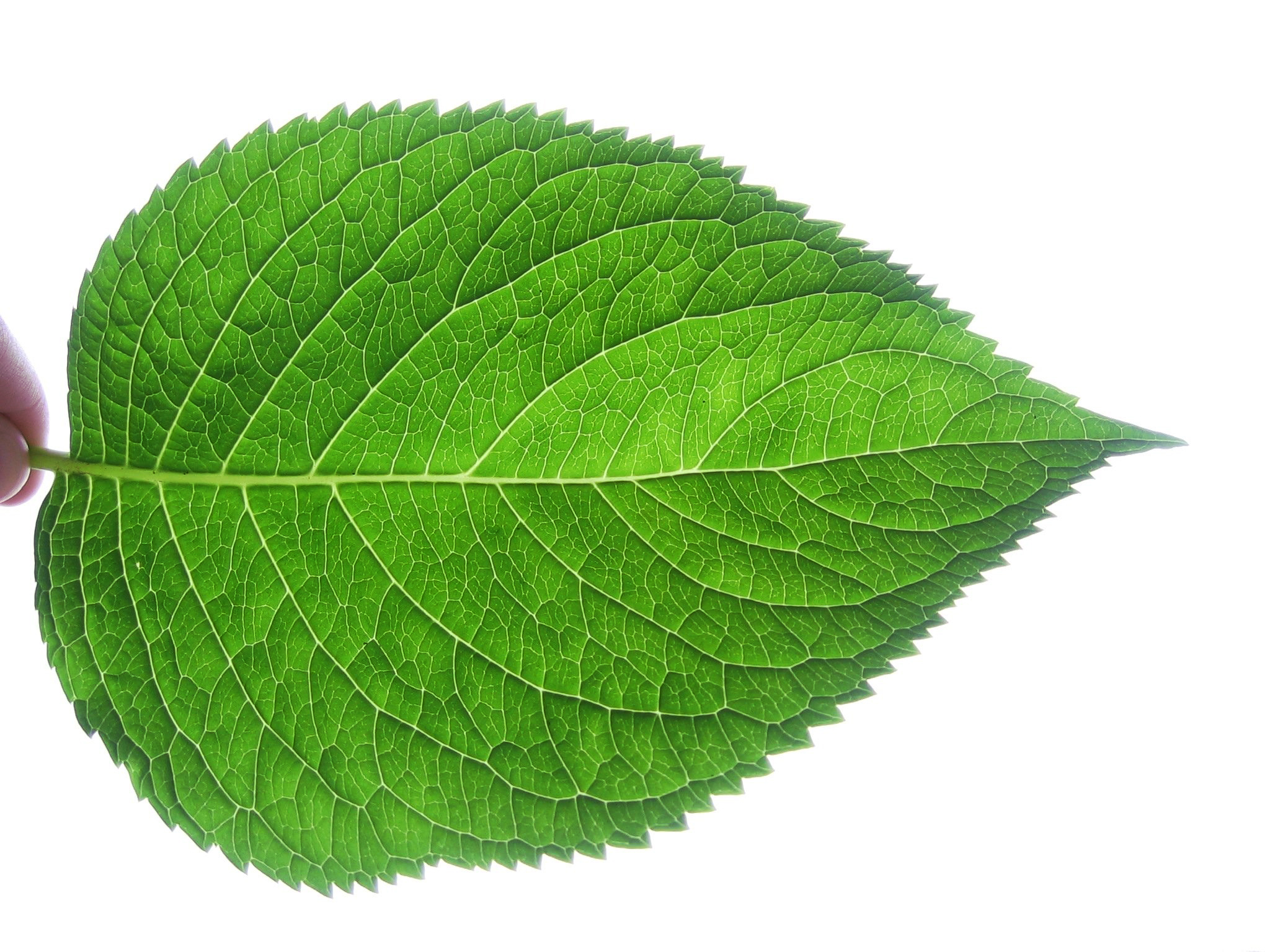 |
| Veins of leaf under public domain via Wikimedia Commons |
A famous fractal known as the Mandelbrot set reveals striking similarity to much of the above branching stuff:
HexagonsHumankind has only recently been able to truly appreciate the beauty of symmetry in crystal structures - especially that of snowflakes. Even though each one is unique, they all showcase an exquisite hexagonal pattern of finest detail (pictures courtesy of Kenneth G. Libbrecht from http://www.its.caltech.edu/~atomic/snowcrystals/): 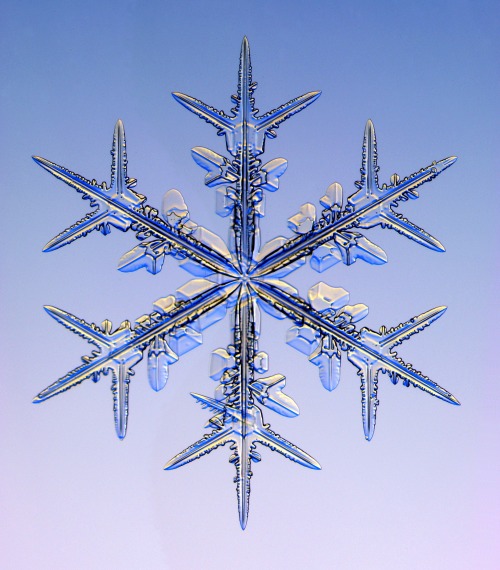 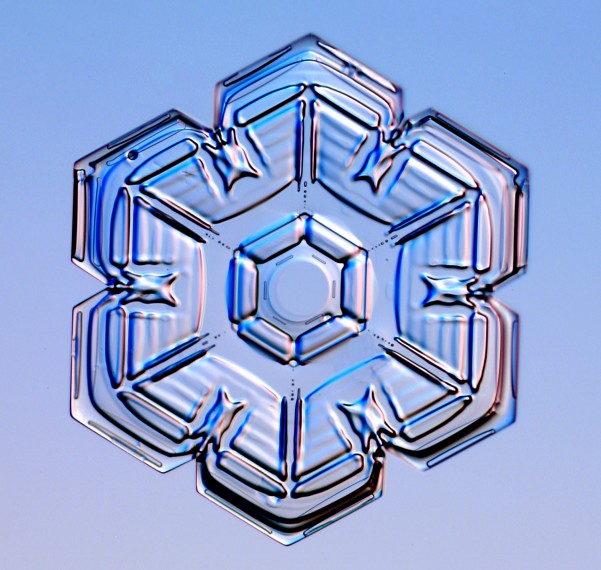 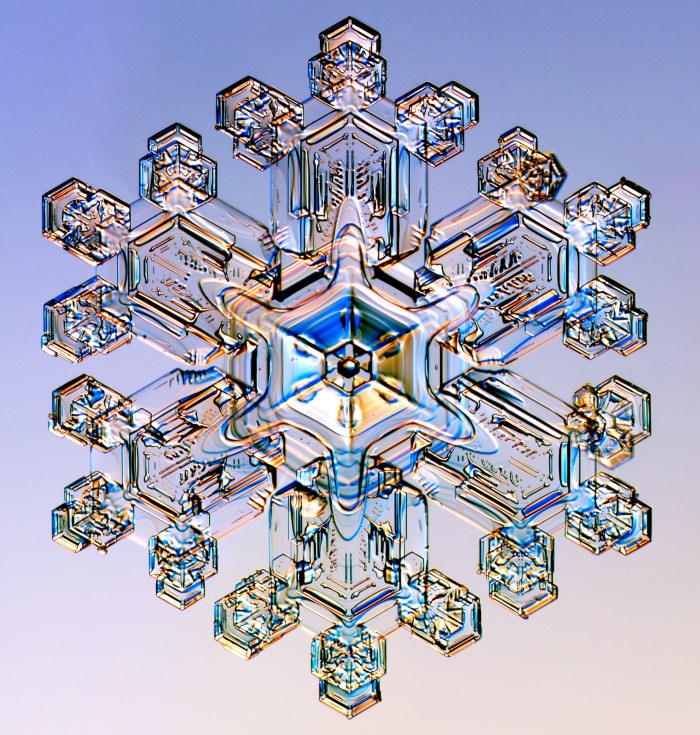
With the advent of the Scanning Electron Microscope, scientists discovered the meticulous elegance of these humble flakes which fall unnoticed in countless hoards:
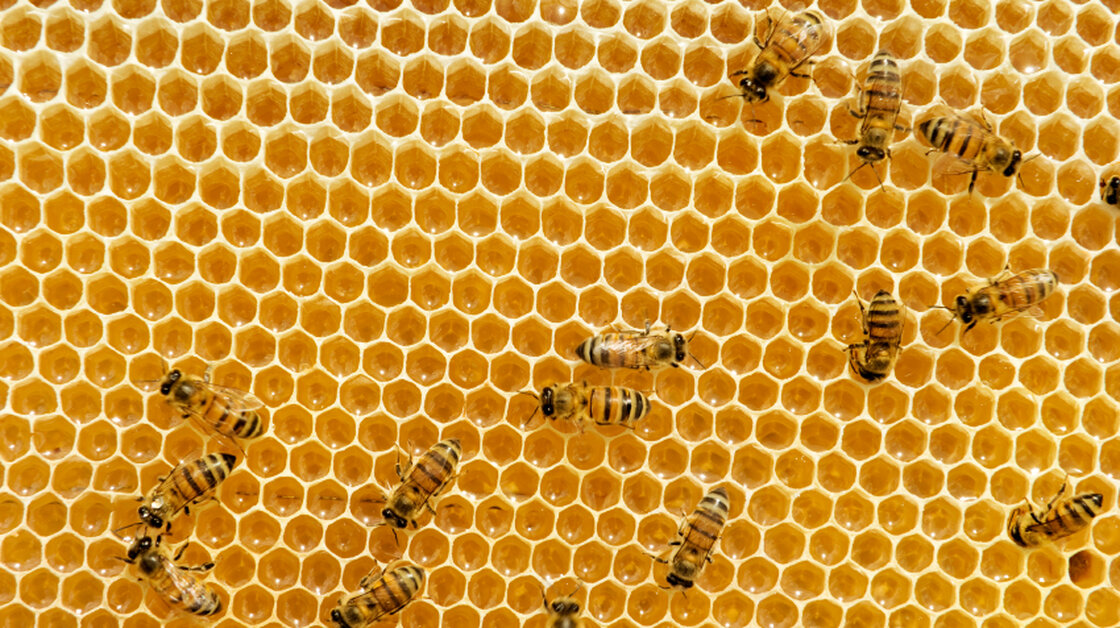
Who told the water molecules to stop linking once they reach the edge of the pit shown above? Similarly, who told these bees that a hexagon provides the optimal combination of strength and capacity for their honeycombs?
 Logarithmic Spirals
And so it is that we live in a world wrought with mathematical intricacies often as unassuming as a softly drifting snowflake, a bustling bees nest, or a dull piece of pencil graphite. A humble creature that illustrates this truth is the all-too-often forgotten chambered nautilus. I mean, when last did you stop to consider this odd molusk? Specifically, have you ever thought of writing down an equation to trace out its shell? The parametric curve known as a Logarithmic Spiral models a radius that expands exponentially with the angular coordinate theta:
 
Okay, don't let this teeny equation scare you off; just appreciate its influence in the natural realm from nautilus shells...
... to sunflowers...
... to lizard tails...
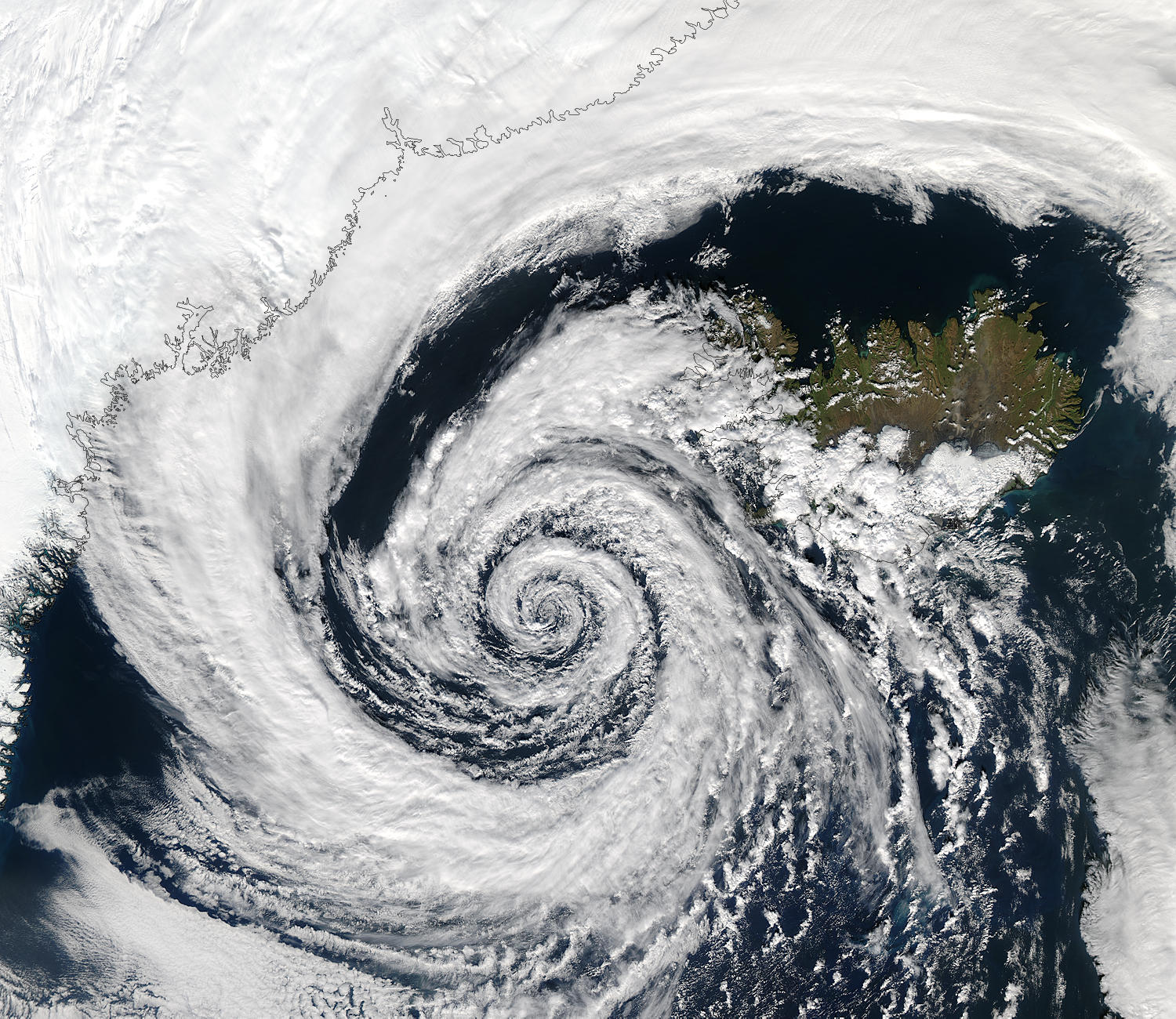
... to hurricanes...
... to spiral galaxies!
Like "déjà vu" the logarithmic spiral also thrives in the Mandelbrot set:
For obvious reasons, mathematicians refer to this feature in the Mandelbrot set as a "seahorse tail".
Ran out of timeBeautiful isn't it? My hope in this blog post was to share some awe-inspiring aspects of creation from a mathematical perspective. There have been books written on mathematics in nature and I could only hope to catch a glimpse of this fascinating subject. However, I consider that every physics textbook is really a testament to the pervasiveness of math throughout the cosmos. As physicist Eugene Wigner concluded in his paper The Unreasonable Effectiveness of Mathematics in the Natural Sciences:"The miracle of the appropriateness of the language of mathematics for the formulation of the laws of physics is a wonderful gift which we neither understand nor deserve." While secularists cannot reason why the immaterial abstractions of, say, the Mandelbrot set surface throughout nature, the Christian recognizes both the physical and conceptual worlds as reflections of a Creator's infinite mind: "Oh, the depth of the riches and wisdom and knowledge of God! How unsearchable are his judgments and how inscrutable his ways!" ~ Romans 11:33
This scripture reveals how the intangible institutes of the mathematical realm were used in the blueprints of a masterpiece - our visible universe:
"By faith we understand that the universe was created by the word of God, so that what is seen was not made out of things that are visible." ~ Hebrews 11:3
Video 1: Slow motion lightning branching: https://www.youtube.com/watch?v=6MUYsIjTKvk
Video 2: A fantastic presentation on mathematical and natural fractals by creationist Dr. Jason Lisle: https://www.youtube.com/watch?v=nkwCl0ymTfg
|






No comments:
Post a Comment