Sunday, October 19, 2014

Virtual Violence, Real Effects

When Nintendo and Atari introduced the 1990's to a new two-dimensional world of Marios, Sonics, and Zeldas, one could hardly envision the development of modern virtual reality entertainment. While today's top titles like Call of Duty, Halo, or Grand Theft Auto are masterpieces of realism, gamers are exposed to an increasingly intrusive degree of gore and violence. Aggressive influences grieve the brain steeped in violent video games, and research warns of impacts from a personal to societal level.

What attracts people to this?
What sets violence in video games apart from other media is the degree of user interaction. Unlike passively watching a movie, playing a video game requires you to "interact with the game psychologically and emotionally as well. You’re not just watching the characters on screen; you’re becoming those characters."6 What's more, this concentration on virtual aggression is rewarded by progressing through the game. The brain becomes numbed3 to violent imagery and extreme responses in a fantasy realm well on its way to virtual reality.

Have you considered why game developers strive for higher tiers of realism? Can it be that gamers are best entertained exactly when their brains are best fooled into responding sincerely to a virtual environment? Or is it that their successes in the game come closer to realization as concrete achievements? In either case, violent video games foster cognitions that interpret false brutality as a channel to ease psychological strain4.

The observation that individuals already struggling with depression, frustration, and aggression will likely prefer violent gaming does not dismiss a symbiotic relationship between game violence and these negative traits. In fact, such video games work to deepen the darkness of a troubled mind. The virtual realm can serve as a playground, or rather, a boot camp for frightening mental pathways with the potential of translating into the gamer's physical world. Anderson and Dill report that violent video games "provide a forum for learning and practicing aggressive solutions to conflict situations."

Call of Duty: Black Ops II grossed $1billion within 15 days of release.
Photo: http://thecybersafetylady.com.au/
Young people with a mind desensitized to violence and trained to respond aggressively in stressful circumstances are a great risk to their communities. Even subconscious thinking patterns can propagate from the virtual world to harm real people. The horrors of recent shootings across America have reconciled many to the idea that video game violence can contribute to such cold-hearted atrocities. Practice makes perfect, and Adam Lanza had already completed 83,000 kills in online gaming before taking the first life at Sandy Hook Elementary School.

But often the link of violent media to increased crime and delinquency is made the critical factor in this discussion. On account of studies5 which failed to identify such a link, gamers hastily conclude that screen violence will not affect less conspicuous psychological expressions. Though neither a necessary nor sufficient cause for alleged societal woes, violent video game exposure is a "causal risk factor for increased aggressive behavior, aggressive cognition, and aggressive affect and for decreased empathy and prosocial behavior."1

In summary, a growing research base suggests that violent video game exposure has "lasting deleterious effects on brain function and behavior"3 which encourage aggression on an individual and ultimately societal level. Am I arguing that one shouldn't play violent video games at all? On a personal level, one must be convinced that this activity has no power to induce even subconscious violent traits and harmful responses. On the contrary, for those seeking a medium in which to express and cultivate such antisocial pathways, violent video games will presumably continue to serve as an excellent platform.

In the above discussion (which is taken from an essay I wrote) I argued purely from a secular stance. There are clear scriptural reasons why a Christian should not partake in violent video gaming which I've not covered in this article. Just one scripture which speaks strongly on the subject is Psalm 11:5: 

"The LORD tests the righteous, but his soul hates the wicked and the one who loves violence."

Works Cited:

1.      Anderson, Craig A., et al. "Violent video game effects on aggression, empathy, and prosocial behavior in eastern and western countries: a meta-analytic review." Psychological bulletin 136.2 (2010): 151.
2.      Anderson, Craig A., and Karen E. Dill. "Video games and aggressive thoughts, feelings, and behavior in the laboratory and in life." Journal of personality and social psychology 78.4 (2000): 772.
3.      Bartholow, Bruce D., Brad J. Bushman, and Marc A. Sestir. "Chronic violent video game exposure and desensitization to violence: Behavioral and event-related brain potential data." Journal of Experimental Social Psychology 42.4 (2006): 532-539.
4.      Bushman, Brad J., and Jodi L. Whitaker. "Like a Magnet Catharsis Beliefs Attract Angry People to Violent Video Games." Psychological science 21.6 (2010): 790-792.
5.      Ferguson, Christopher J. "Video games and youth violence: A prospective analysis in adolescents." Journal of youth and adolescence 40.4 (2011): 377-391.

6.      Huntemann, Nina, dir. Game Over: Gender, Race & Violence in Video Games. Media Education Foundation, 2002. Film.

Monday, October 6, 2014

Lightning, Broccoli, Nautiluses, and Snowflakes?

[A scattered blog post with lots of eye candy.]


Lightning, broccoli, nautiluses, and snowflakes all demonstrate the integration of mathematical concepts in material entities. Here's a taste of an important subject you may never have considered deeply; I hope this brief discussion will instill a greater appreciation of the elegance in every created thing...


Fractals

Romanesco Broccoli. Photo by Jon Sullivan, licensed under public domain via Wikimedia Commons

Wow. Yes, that is broccoli, and yes, I have eaten one of these. What delights the eye though, about the Romanesco Broccoli is its elegant resemblance to a complex mathematical structure known as a fractal. Notice how each small cone-like growth is patterned with smaller cones, that each are patterned with smaller cones, that each are... you get the point? Although mathematically this "self-similar" sequence iterates into infinite detail, many natural structures exhibit unavoidable similarity to fractals.

Even the thundering stampede of charge in a lightning bolt propagates in a fractal-like pattern (see Video 1 at end):
Electrifying volcanic lightning from photography.nationalgeographic.com
 In fact, this pattern also manifests itself in tree branches, blood vessels, river networks, and leaf veins (to name a few):
 Branches. Under public domain via Wikimedia Commons


Blood vessels from http://blogs.uoregon.edu/artofnature.
Amazon river basin from Global Rain Forest Mapping Project/NASA/JPL
 Veins of leaf under public domain via Wikimedia Commons
A famous fractal known as the Mandelbrot set reveals striking similarity to much of the above branching stuff:


Work of Anton Feenstra from http://www.chem.vu.nl/~feenstra/mandel_gallery.html
Amazing as they are, I will not risk getting off track explaining the characteristics of the Mandelbrot set (I highly recommend Video 2 at the end). 


Hexagons


Humankind has only recently been able to truly appreciate the beauty of symmetry in crystal structures - especially that of snowflakes. Even though each one is unique, they all showcase an exquisite hexagonal pattern of finest detail (pictures courtesy of  Kenneth G. Libbrecht from http://www.its.caltech.edu/~atomic/snowcrystals/):


With the advent of the Scanning Electron Microscope, scientists discovered the meticulous elegance of these humble flakes which fall unnoticed in countless hoards:
Licensed under Public domain via Wikimedia Commons

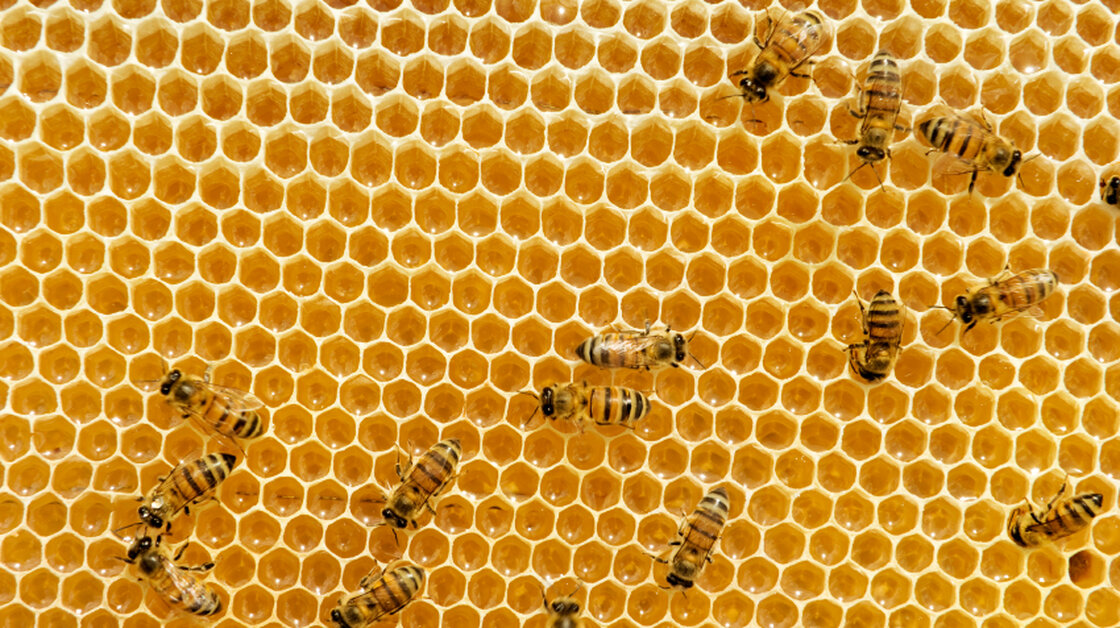
Who told the water molecules to stop linking once they reach the edge of the pit shown above? Similarly, who told these bees that a hexagon provides the optimal combination of strength and capacity for their honeycombs?


iStockphoto.com
Yet again, with the advent of the Scanning Tunneling Microscope, scientists could visualize hexagonal structures on the most fundamental level:


That's a scan from my research of the graphite surface where carbon atoms arrange in a punctual honeycomb lattice.


Logarithmic Spirals


Humble nautilus from science.nationalgeographic.com/
And so it is that we live in a world wrought with mathematical intricacies often as unassuming as a softly drifting snowflake, a bustling bees nest, or a dull piece of pencil graphite. A humble creature that illustrates this truth is the all-too-often forgotten chambered nautilus. I mean, when last did you stop to consider this odd molusk? Specifically, have you ever thought of writing down an equation to trace out its shell? The parametric curve known as a Logarithmic Spiral models a radius that expands exponentially with the angular coordinate theta: 

r = ae^{b\theta}\,


Okay, don't let this teeny equation scare you off; just appreciate its influence in the natural realm from nautilus shells...

Licensed under Creative Commons Attribution-Share Alike 4.0 via Wikimedia Commons
... to sunflowers...
http://www.goldenspiralmarketing.com/story/golden-ratio
... to lizard tails...

http://contagiousrealism.tumblr.com/post/18117256854

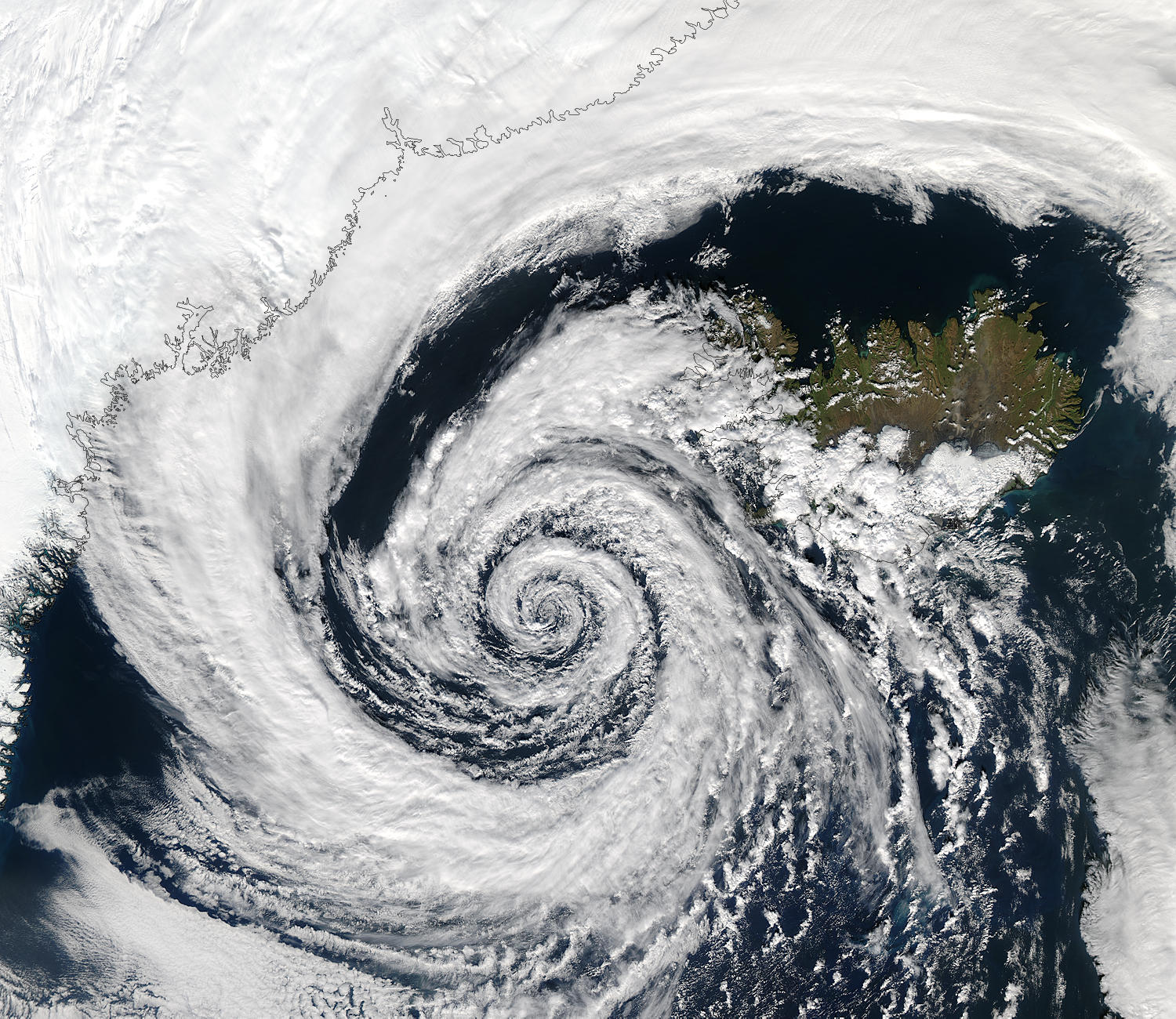
... to hurricanes...

  • Jacques Descloitres, MODIS Rapid Response Team, NASA/GSFC
... to spiral galaxies!

Grand Spiral Galaxy NGC 1232 from http://apod.nasa.gov/apod/ap120107.html
Like "déjà vu" the logarithmic spiral also thrives in the Mandelbrot set:

Licensed under Creative Commons Attribution-Share Alike 3.0 via Wikimedia Commons
For obvious reasons, mathematicians refer to this feature in the Mandelbrot set as a "seahorse tail". 


Ran out of time

Beautiful isn't it? My hope in this blog post was to share some awe-inspiring aspects of creation from a mathematical perspective. There have been books written on mathematics in nature and I could only hope to catch a glimpse of this fascinating subject. However, I consider that every physics textbook is really a testament to the pervasiveness of math throughout the cosmos. As physicist Eugene Wigner concluded in his paper The Unreasonable Effectiveness of Mathematics in the Natural Sciences:
"The miracle of the appropriateness of the language of mathematics for the formulation of the laws of physics is a wonderful gift which we neither understand nor deserve."

While secularists cannot reason why the immaterial abstractions of, say, the Mandelbrot set surface throughout nature, the Christian recognizes both the physical and conceptual worlds as reflections of a Creator's infinite mind: 
"Oh, the depth of the riches and wisdom and knowledge of God! How unsearchable are his judgments and how inscrutable his ways!" 
~ Romans 11:33
This scripture reveals how the intangible institutes of the mathematical realm were used in the blueprints of a masterpiece - our visible universe:
"By faith we understand that the universe was created by the word of God, so that what is seen was not made out of things that are visible."
~ Hebrews 11:3

Video 1: Slow motion lightning branching: https://www.youtube.com/watch?v=6MUYsIjTKvk
Video 2: A fantastic presentation on mathematical and natural fractals by creationist Dr. Jason Lislehttps://www.youtube.com/watch?v=nkwCl0ymTfg